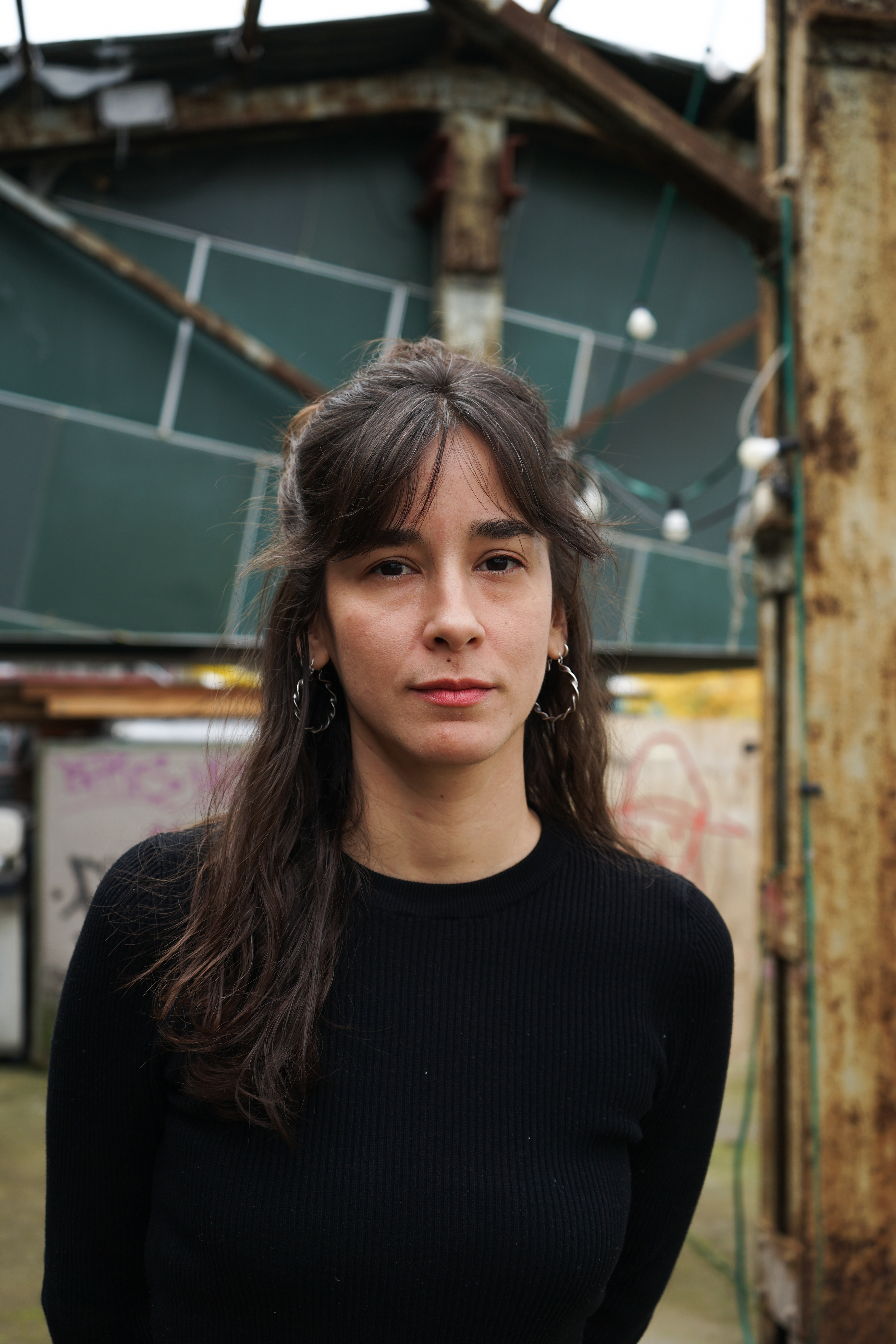
© Elisa Georgi
Flora Paim is a Brazilian artist, architect-urbanist, and researcher based in Portugal since 2016. Her work brings together artistic research, critical spatial practices, and urban studies, with attention to the material, sensory, and political dimensions of places.
Through fieldwork and situated knowledge, she develops research processes attentive to territories in transformation, unfolding into installations, objects, textile and graphic pieces, landscape interventions, writing, publications, visual and textual essays, performative walks, and audio walks. She also works in production and costume design for film, as well as set design for live performances.
She holds a Master’s degree in Art and Design for Public Space from the Faculty of Fine Arts, University of Porto (2016–2018), and a degree in Architecture and Urbanism from the Federal University of Alagoas, Brazil (2007–2014). She is a researcher at the Art History Institute (IHA–NOVA FCSH/IN2PAST), where she conducted doctoral research in Artistic Studies – Art and Mediations (NOVA FCSH, 2021–2026), supported by a grant from the Portuguese Foundation for Science and Technology (FCT). She is also a member of the Extreme Sites research platform (CEAA–ESAP).
Her practice brings together artistic research, fieldwork, archives, image, writing, installation, objects, publications, textile and graphic works, performative walks, and audiowalks. Drawing on situated knowledge, she develops work attentive to the material, affective, and political dimensions of places, particularly territories undergoing transformation.
Since 2017, she has been researching urban vacant lands in Portugal: ruined or emptied sites that appear to have been “abandoned” through deindustrialisation or urban restructuring, yet retain signs of informal human and more-than-human activity. This research has unfolded through works that question notions of emptiness, place, memory, ruination, archive, the commons, and informality.
↓
florapaimd@gmail.com ✴︎ @florpaim